
A court order for maintenance is intended to provide financial support to an eligible spouse, child or parent. However, obtaining a maintenance order does not always mean that payments will arrive regularly. Sometimes, the person directed to pay maintenance misses instalments, pays only part of the amount or stops paying altogether.
When this happens, the person entitled to receive maintenance may need to take further legal steps to enforce the order and seek recovery of unpaid amounts.
If you are dealing with non-payment of maintenance in Bangalore, it is important to understand the type of order you have received, the court that passed it and the procedure applicable to your case. The appropriate remedy can differ depending on whether maintenance was ordered in proceedings under criminal procedure law, domestic violence law, matrimonial law or another applicable legal provision.
This guide explains how maintenance order enforcement works, what documents may be required and how a family law advocate can assist.
What Is a Maintenance Order?
A maintenance order is a direction issued by a competent court requiring one person to provide financial support to another person who is legally entitled to receive it.
Depending on the applicable law and the circumstances, maintenance may be awarded to:
A wife or spouse who meets the relevant legal requirements.
A child who is entitled to financial support.
A parent who satisfies the applicable legal conditions.
An eligible applicant seeking monetary relief in domestic violence proceedings.
Maintenance may be ordered temporarily while a case is pending or as part of a final order. The order may specify the amount payable, the payment frequency, the date from which payments are due and any other relevant conditions.
The exact terms of the court order are important because enforcement generally depends on what the court has directed.
What Can You Do If Maintenance Payments Are Not Made?
If the person directed to pay maintenance fails to comply with the order, the first step is to review the order and identify the unpaid instalments.
Avoid relying only on verbal discussions or informal promises. Keep a clear record of the amounts due, the payments received and the dates on which payments were missed.
The following steps can help you prepare for enforcement proceedings.
1. Obtain and review the maintenance order
Keep a complete copy of the order passed by the court. Check the amount awarded, the effective date, payment deadlines and any specific directions regarding payment.
If an interim maintenance order has been passed during ongoing proceedings, it may still be enforceable according to the applicable legal procedure.
2. Calculate the unpaid maintenance
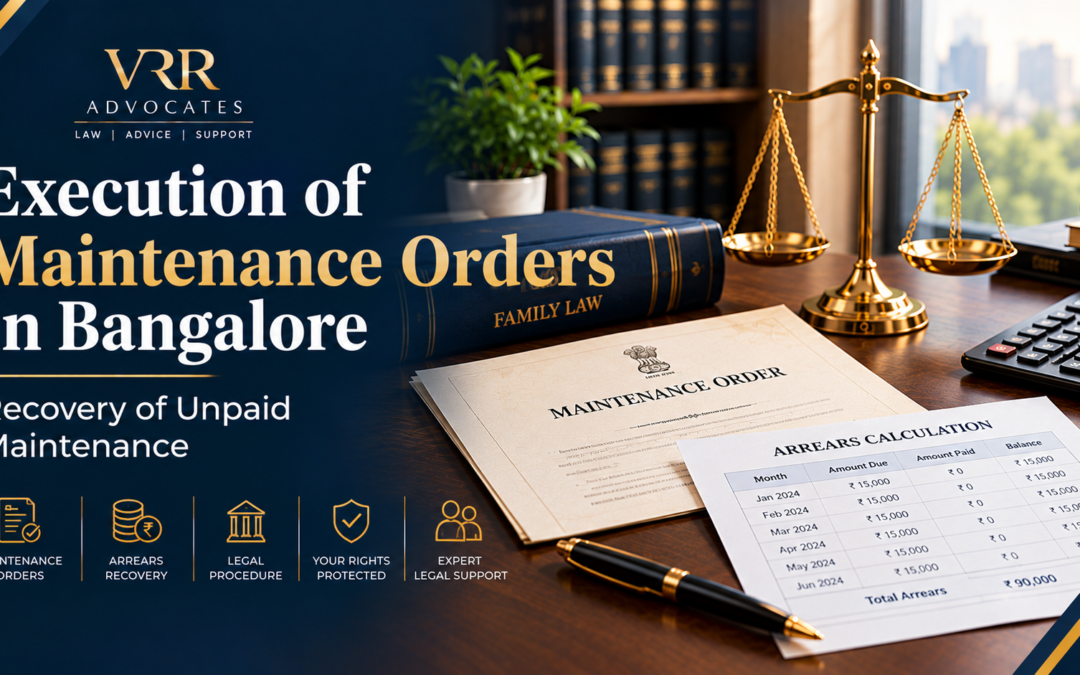
Prepare a month-by-month statement showing the amount due, the amount received and the outstanding balance.
For example, if maintenance was ordered at a fixed monthly amount and several instalments remain unpaid, list each unpaid month separately. Include any partial payments and retain supporting bank records.
The calculation should follow the court’s order and account for payments already received. Do not automatically add interest, penalties or other amounts unless there is a legal basis for doing so.
3. Collect evidence of non-payment
Relevant records may include bank statements, transaction histories, payment receipts, messages acknowledging missed payments and previous communications about the outstanding amount.
If the other party claims to have paid in cash, through another account or by another method, the records may help clarify the dispute.
4. Identify the appropriate enforcement procedure
The next step depends on the law under which the order was passed. A maintenance order made under one legal provision may require a different enforcement application from an order made under another.
A lawyer can review the order, determine the appropriate forum and prepare the required application or petition.
Legal Provisions for Enforcing Maintenance Orders
Several legal provisions may be relevant to maintenance enforcement in India. The correct provision depends on the nature of the original proceedings and the applicable law.
Maintenance under the Bharatiya Nagarik Suraksha Sanhita, 2023
Section 144 of the Bharatiya Nagarik Suraksha Sanhita, 2023 (BNSS) deals with orders for maintenance of wives, children and parents in specified circumstances.
Section 147 addresses enforcement of maintenance orders made under the relevant framework. It provides for enforcement by a Magistrate in a place where the person against whom the order was made may be found, subject to the statutory requirements.
The law also contains procedural requirements concerning recovery of amounts due. In particular, the timing of an application can be important, so applicants should obtain legal advice promptly rather than allowing arrears to accumulate.
Orders and proceedings governed by earlier law may raise transitional questions. The applicable procedure should be confirmed from the date and nature of the original order rather than assuming that the same provision applies in every case.
Maintenance under the Protection of Women from Domestic Violence Act, 2005
In appropriate cases, monetary relief under Section 20 of the Protection of Women from Domestic Violence Act, 2005 may include maintenance for the aggrieved woman and her children.
The Act provides mechanisms relevant to the implementation of monetary relief orders. For example, Section 20(6) allows a Magistrate, in the circumstances specified by law, to direct an employer or debtor of the respondent to pay or deposit an appropriate portion of wages, salary or debt towards the monetary relief.
The remedy available will depend on the terms of the order and the circumstances of the default.
Maintenance awarded in matrimonial or family proceedings
Maintenance may also be ordered under other applicable matrimonial or family-law provisions. The enforcement route will depend on the statute, the nature of the order and the court that issued it.
It is therefore important not to file a generic application without checking the legal basis of the existing order. A lawyer should identify the appropriate enforcement mechanism and any relevant limitation or procedural requirements.
How Does Maintenance Arrears Recovery Work in Bangalore?
The procedure can vary from case to case, but a typical enforcement process may involve the following stages.
Step 1: Review the original proceedings
The advocate examines the maintenance order, the case details and the payment conditions. The purpose is to establish which court or authority can entertain the enforcement request.
Step 2: Prepare an arrears statement
A clear calculation of unpaid maintenance is prepared. This should identify each instalment due and credit any amounts already paid.
Supporting bank records and other payment evidence should be organised in chronological order.
Step 3: File the appropriate application
The required application is prepared under the relevant legal provision and filed before the competent court or authority. It may seek enforcement of the existing order and recovery of amounts legally due.
The application should accurately state the period of default and the relief requested.
Step 4: Respond to the other party’s objections
The person required to pay maintenance may dispute the calculation, claim that payments were made or seek other relief available under law.
The court may examine the records, hear the parties and determine the appropriate next step.
Step 5: Follow the court’s directions
Depending on the applicable statute and facts, the court may use legally available enforcement measures. The outcome could involve directions for payment or other recovery mechanisms permitted by law.
The time required will depend on the court’s schedule, the completeness of the documents, the nature of any objections and the enforcement method available.
Documents Required for Enforcement of a Maintenance Order
Preparing the relevant documents before filing can help reduce avoidable delays. Depending on the case, you may need:
A certified or otherwise appropriate copy of the maintenance order.
Details of the original case, including the case number and court.
A month-wise statement of unpaid maintenance.
Bank statements or payment records showing amounts received.
Receipts or other evidence of partial payments.
Relevant messages or correspondence about missed payments.
Available information about the paying party’s employment or income, where relevant to the proposed remedy.
Identification and case-related documents required by the court.
Copies of previous applications or orders relevant to enforcement.
Not every case requires every document listed above. Your advocate can confirm the documents required for the particular proceedings.
Can a Person Be Penalised for Not Paying Maintenance?
Failure to comply with a maintenance order can have legal consequences, but the available consequences depend on the applicable statute, the wording of the order and the facts of the case.
A court may consider statutory recovery or enforcement measures where the legal requirements are met. The paying party may also raise a genuine dispute about payment, calculation or other relevant circumstances, which the court can examine.
Non-payment should not automatically be treated as proof that a particular penalty will follow. Equally, the recipient should not assume that the order must remain unenforced merely because the other party refuses to cooperate.
Prompt legal advice helps clarify the available remedies and the evidence needed to support them.
What If the Paying Party Claims They Cannot Afford Maintenance?
A person directed to pay maintenance may claim that their income has decreased, they have lost employment or their financial circumstances have changed.
Such a claim does not, by itself, mean that an existing court order can simply be ignored. The person concerned may need to approach the appropriate court for modification or other relief available under the applicable law.
Until the order is modified, stayed or otherwise dealt with by a competent court, the parties should obtain legal advice on their obligations and the consequences of non-compliance.
The recipient should preserve records of missed payments and respond to any formal application through the appropriate legal process.
How Long Does Maintenance Recovery Take in Bangalore?
There is no single timeline for every maintenance enforcement case. Some applications may proceed more quickly than others, while contested matters or cases involving difficulties in recovery can take longer.
The following factors may affect the timeline:
Whether the maintenance order and payment records are complete.
The number of unpaid instalments.
Whether the other party disputes the arrears calculation.
Whether the paying party’s location or income details are available.
The court’s workload and hearing schedule.
The enforcement mechanism available under the relevant law.
Keeping accurate records and filing the correct application can help avoid unnecessary procedural delays, although no particular outcome or timeline can be guaranteed.
Common Mistakes to Avoid
People seeking recovery of unpaid maintenance may unintentionally weaken or delay their applications by making avoidable mistakes.
Waiting too long to seek enforcement: Some statutory procedures have time-sensitive requirements. Obtain legal advice as soon as payments are missed.
Keeping no payment records: A month-wise calculation supported by bank statements and receipts is more useful than an approximate total.
Assuming every maintenance order follows the same process: The applicable law and the original court order determine the enforcement route.
Ignoring partial payments: Record all payments accurately so that the amount claimed reflects the actual outstanding balance.
Relying only on informal assurances: Keep written records of relevant communications and follow the formal court process when necessary.
Filing without checking the order: The amount, effective date and payment conditions should be verified before calculating arrears or requesting recovery.
Frequently Asked Questions
1. Can I recover unpaid maintenance in Bangalore?
Depending on the applicable law and the terms of the order, you may apply to the competent court or authority for enforcement and recovery of maintenance arrears. The correct procedure should be identified from the original order.
2. Do I need a lawyer to enforce a maintenance order?
You should seek legal advice to identify the appropriate enforcement procedure, calculate arrears and prepare the necessary documents. Whether legal representation is mandatory for a particular procedural step depends on the applicable rules and circumstances.
3. Can I seek enforcement of an interim maintenance order?
An interim maintenance order may be enforceable according to the applicable law and the terms of the order. If payments are missed while the main case is pending, obtain advice on the correct procedure without waiting for the final decision.
4. What if only part of the maintenance has been paid?
Prepare a record of the amount due and every payment received. An enforcement application should generally seek the legally outstanding balance, taking account of payments already made.
5. Can maintenance arrears be claimed for earlier months?
Recovery depends on the original order, the applicable statute, when the amounts became due and any relevant procedural time limits. The entire arrears period should be reviewed by an advocate before filing.
6. What if the paying party lives outside Bangalore?
The appropriate enforcement route may depend on the relevant law, the location of the parties and the nature of the order. Some statutory provisions allow enforcement beyond the place where the original order was made. Obtain advice before deciding where to file.
7. How much does it cost to enforce a maintenance order?
Legal fees and case-related expenses depend on the complexity of the matter, the amount of documentation required, the number of hearings and the enforcement steps involved. VRR Advocates can discuss the likely scope of work and available consultation options after reviewing the case details.
8. Can I consult a Bangalore family law advocate online?
An initial online consultation may be useful for reviewing the order, discussing unpaid instalments and understanding the possible next steps. Whether the matter can be handled remotely or requires an in-person appearance depends on the case and applicable court procedures.
How VRR Advocates Can Help
VRR Advocates assists clients seeking guidance on family-law matters in Bangalore, including maintenance disputes and enforcement-related issues.
Depending on the facts of your case, legal assistance may include:
Reviewing the maintenance order and identifying the relevant legal provisions.
Preparing a clear calculation of outstanding maintenance.
Assessing available enforcement options.
Organising supporting documents and payment records.
Preparing or responding to the appropriate legal application.
Advising on the next steps if the other party disputes the arrears or claims a change in financial circumstances.
The appropriate approach depends on the original order, the applicable law and the evidence available. Legal advice can help you understand your options before taking further action.
Conclusion
Non-payment of court-ordered maintenance can create serious financial difficulties for the person entitled to receive it. However, an existing maintenance order may be enforceable through legal procedures, subject to the applicable statute and the facts of the case.
If maintenance payments have stopped, review the order, prepare a month-wise account of the arrears, collect payment evidence and seek advice on the correct enforcement procedure. Acting promptly can help protect your position and reduce the risk of avoidable procedural complications.
For guidance on execution of maintenance orders in Bangalore, VRR Advocates can help you understand the relevant legal options and the next steps appropriate to your circumstances.
Legal Disclaimer: This article is for general informational purposes only and does not constitute legal advice. Laws, procedures and available remedies depend on the facts of each case. Consult a qualified advocate before taking legal action.
